
Client
ARE Austrian Real Estate GmbH
(represented by Bundeimmobiliengesellschaft m.b.H.)
General Planning
F+P ARCHITEKTEN ZT GmbH
Architecture
F+P ARCHITEKTEN ZT GmbH / Architekten Maurer & Partner ZT GmbH
Gross floor area: approx. 9.500 m2
Refurbishment and Extension of the AGES Site on Spargelfeldstraße
Competition
1220
Vienna,
Spargelfeldstraße 191,
Austria
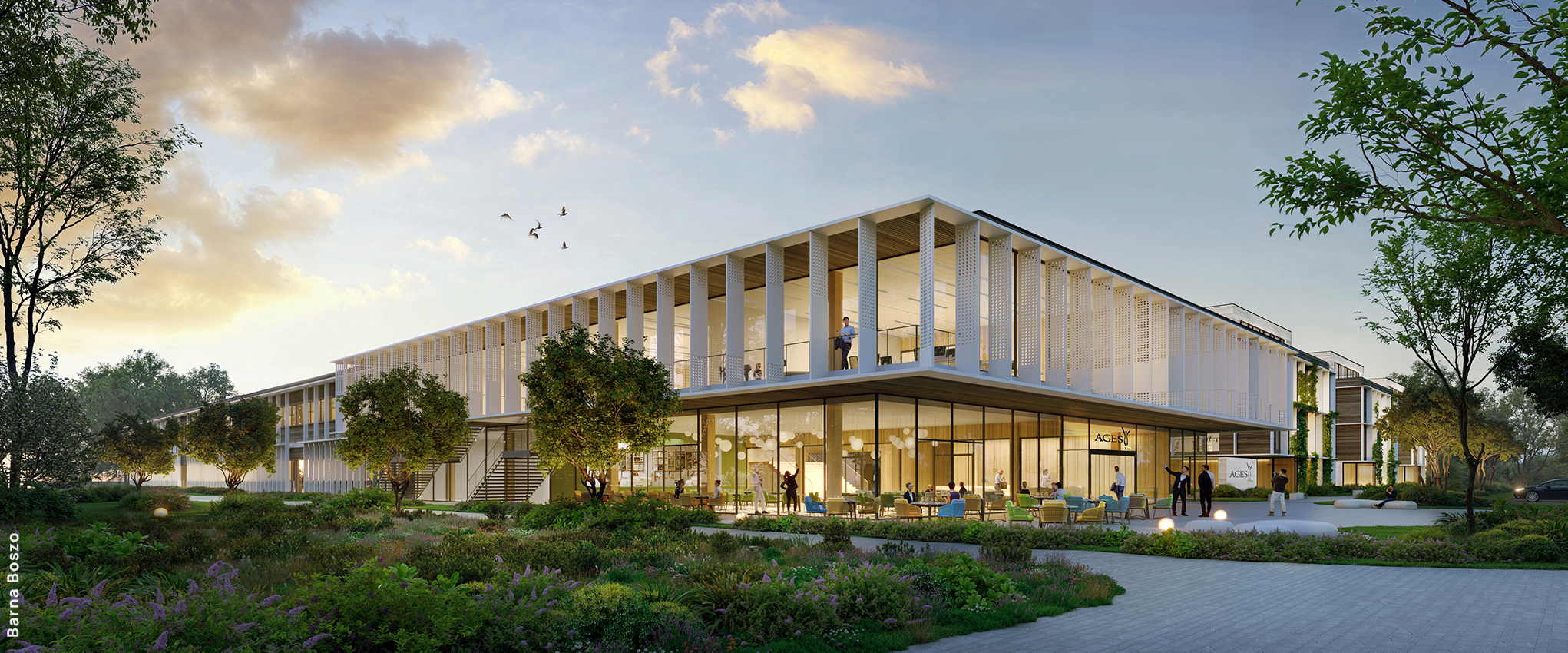
As part of the AGES competition, a future-oriented concept was developed for the modernization and new construction of the AGES laboratory and office campus on Spargelfeldstraße in Vienna’s 22nd district.
Structural and Construction Concept
The aim was to develop a design based on an efficient timber hybrid construction system with a high degree of prefabrication. Load-bearing timber columns were combined with reinforced concrete components in the laboratory areas as well as hollow-core slabs in the seminar areas, enabling large spans, high functional flexibility, and an economical construction method.
The horizontal load-bearing reinforced concrete elements allow for structural activation to thermally utilize the building mass.
Prefabrication and Integration of the Existing Structure
To reduce construction time and costs, the use of prefabricated semi-finished and fully prefabricated elements, timber columns, and large-scale timber frame façade elements was envisaged.
The new building would have been partially constructed on the existing basement level; due to the column-based structural system, only selective interventions in the form of new pad foundations would have been required.
Circular Economy and Existing Buildings
In line with circular economy principles, maximum retention of the load-bearing structure was pursued in the existing buildings. The façades of selected buildings were planned as suspended timber element façades.
Sustainability and Architectural Expression
The project would have been designed to achieve klimaaktiv Gold certification and, in planning, meets the naBe criteria as well as the requirements of the EU Taxonomy. A highly insulated, thermal-bridge-optimized building envelope, energy-efficient systems, and the use of renewable energy sources contribute to a low heating energy demand and a reduction in CO₂ emissions.
The planned dark, carbonized timber façade is complemented by a projecting trellis structure, façade greening, and integrated architectural sun shading.